
Calhoun County Youth Center Discharge Decisions
Calhoun County Youth Center is a secure juvenile detention and programming facility. It is not an adult jail. The detention program serves youth placed by a judge or referee while further court action is pending. The official detention description says discharge occurs only through posting of bond or by order of the court. Those decisions may return a child to a parent or guardian or direct a different lawful placement, but the individual outcome is not a public release-list item.
The juvenile court controls the legal order. Facility staff carry out that order and can provide permitted instructions to people with authority. Public adult tools do neither job. The Sheriff's Police-to-Citizen roster is expressly a current-inmate channel for the adult correctional facility. MDOC OTIS covers people in the state corrections system, not Youth Center detention. MiCOURT's public interface excludes juvenile and child-protective proceedings. None should be used to infer whether a child is detained, discharged, or moved.
| Question | Proper channel |
|---|---|
| May the youth leave detention? | The juvenile court order and authorized Youth Center contact |
| What conditions apply after discharge? | The order, the assigned lawyer, probation officer, or authorized case contact |
| Where was the youth placed? | Only an authorized court or facility channel, subject to confidentiality |
| Why is there no adult roster result? | The adult roster does not cover the Youth Center |
Confidentiality: Do not post, request, or reconstruct a child's custody, discharge, placement, photograph, or case details through public channels.
Calhoun County Youth Center Record Contacts
The official Calhoun County Youth Center page is the first source for current contact information and program notices. Its published contact block lists the facility in Marshall, a direct phone number, email, and weekday administrative hours. Contact staff through those official details. Ask how to prove authorization before sharing more than the minimum needed to route the call.
Calhoun County Youth Center
14555 18 1/2 Mile Road
Marshall, MI 49068
Phone: 269-781-0920
Email: tbenden@calhouncountymi.gov
Administrative hours: Monday-Friday, 8 a.m.-5 p.m.
The contact block gives an administrative route, not permission to disclose a juvenile file. For case documents, the proper division of the court or the child's lawyer can state who may receive them. Michigan courts are outside County FOIA, and Calhoun's public MiCOURT search does not expose juvenile or child-protective proceedings. Do not send a broad request for a roster, release list, or photographs.
The manifest image below was captured from the official Youth Center source.
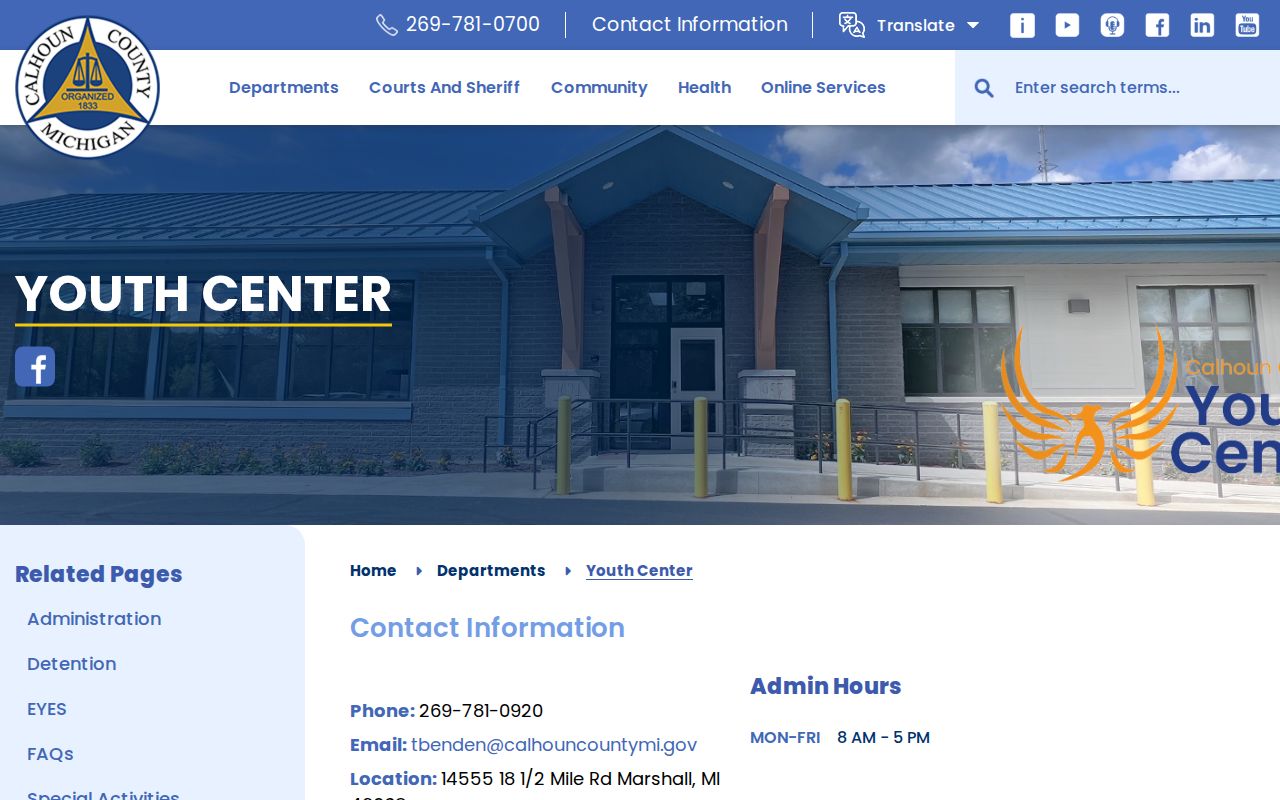
The county page keeps the facility's contact details and program links together, which helps an authorized caller avoid unrelated adult systems.
Confidential Calhoun County Youth Records
A juvenile record follows a need-to-know route. The first question is not whether a public database has a name. It is whether the person asking has legal authority and which court or program controls the matter. Parents, guardians, counsel, and designated case professionals may have different access. Facility staff and the court determine that access under the governing rules and order.
- Authorized contact
- A person whom the law, court, or facility may recognize for the specific youth and purpose.
- Discharge order
- The court direction that permits release from detention or sets the next lawful step.
- Placement
- A court-approved living or program setting. It should not be inferred from a child's absence from detention.
- Confidential record
- Information withheld from general public access and released only through the proper protected process.
Use a private phone call or a secure process given by staff. Avoid leaving a child's full date of birth, allegations, medical facts, school details, home address, or placement information in voicemail unless the agency specifically directs it. Social media and news searches are not lawful substitutes for the record. They can be stale, incomplete, or harmful.
A narrowly framed question helps. An authorized caller may ask, “What must I provide to confirm my authority and receive the court-approved discharge instructions?” That phrasing requests process first. It does not pressure staff to disclose protected facts before identity is checked.
Calhoun County Youth Center Court Records
The Calhoun County Courts directory routes users to the relevant court offices. It should be used for contact, not as a public juvenile case index. County FOIA cannot produce a court file because Michigan courts are not public bodies under that act. The clerk, judge's staff, assigned probation officer, or lawyer can identify the protected process that applies to the specific case.
Public MiCOURT results may include adult criminal cases from Circuit and District Court, but its disclaimer excludes juvenile and child-protective proceedings. The lack of a result is thus built into the public-access boundary. It does not prove that the youth has no case. It also does not reveal whether detention ended, whether bond was posted, or whether the court selected another placement.
The matched screenshot comes from the official county court route.
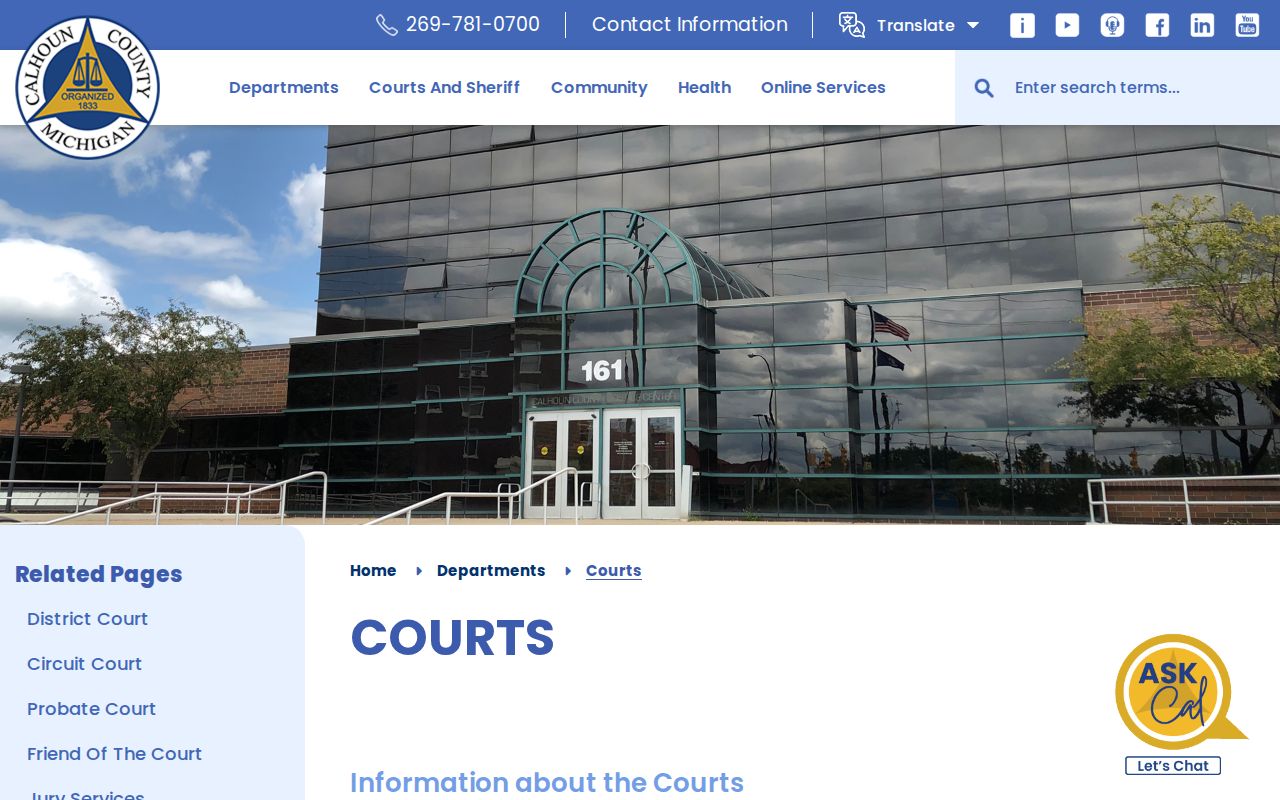
The directory helps an authorized person find the correct office without entering confidential youth details into an adult public-search field.
Calhoun County Youth Center Detention Record
The official detention page describes a short-term, safe, and humane setting for youth awaiting further court action. It serves ages 11 through 17 when a judge or referee orders placement after an alleged offense or court-order violation. The program uses a cognitive behavioral approach, counseling by a licensed therapist, and a token economy intended to teach appropriate conduct. These are program facts. They are not grounds to reveal who is present.
Facility history provides context without exposing a child. Research identifies original structure dating to 1957 and renovation elements from 1975. A recent state funding description covers renovation and expansion and estimates about 200 youth served per year. That annual figure describes service volume, not releases, present occupancy, or a public roster. It must never be divided or reused to estimate an individual outcome.
Calhoun County Youth Center therefore has a purpose and record structure unlike the adult Calhoun County Correctional Facility. The adult facility release page uses Sheriff custody records, current-inmate checks, and transfer routes. Those channels stop at the Youth Center boundary. Juvenile discharge remains with the court and authorized facility contacts.
Note: Historical and annual program figures describe the institution as a whole and do not disclose any child's current or past detention status.
Calhoun County Youth Center Record Boundaries
Several public systems can tempt an incorrect search. Police-to-Citizen belongs to the adult Sheriff's jail route. OTIS belongs to MDOC state corrections. VINELink is a custody and notification aid for participating agencies, but it should not be used to probe confidential juvenile placement. Public registries have their own strict legal scope and do not serve as Youth Center discharge records. An adult search result cannot be joined with online posts to reconstruct a child's history.
Calhoun County release research should keep two clear lanes. Adult criminal custody can have public records and official public locators, which are set out in the Calhoun County released-inmate search. Juvenile detention uses restricted records and approved participants. The lane does not change because a child approaches adulthood or because an adult relative asks. Authority comes from law and the court, not family curiosity or the ease of an online search.
If a youth may be in immediate danger, use emergency services or the case's emergency contact rather than a public record tool. For routine matters, call during the facility's published administrative hours. Ask which secure route applies. Protect documents received through that route, and follow any limits stated by the court or facility.