
Calhoun County Parole and Probation
Parole follows a Michigan prison term. A person on parole has left secure confinement but remains under Michigan Department of Corrections jurisdiction. OTIS, the state Offender Tracking Information System, may show “Parolee,” a Date Paroled, and an Assigned Location. Probation is usually a sentence served in the community under court-ordered terms. A probationer may never have entered state prison. Both state felony groups are overseen by MDOC Field Operations Administration, but the legal path and office assignment can differ.
Calhoun County also operates PTS–Community Corrections for local pretrial matters. That program is not MDOC parole. The official Sheriff jail page identifies the county custody route, but it does not prove that every person who leaves must report to PTS. The distinction matters because a person may be released on bond with an active case, placed on probation at sentencing, paroled from an MDOC prison, or discharged after all state supervision ends.
| Status | How it begins | Best verification | What completion means |
|---|---|---|---|
| Parole | Release from an MDOC prison under supervision | OTIS status, Date Paroled, and Assigned Location | Later discharge ends MDOC jurisdiction |
| Probation | A court orders community supervision | OTIS probationer status plus the court judgment | Discharge or court action closes supervision |
| Pretrial supervision | Release while a criminal case remains pending | Bond papers, MiCOURT, and Calhoun PTS | The court resolves or changes the pending case |
| Discharged | MDOC supervision has ended | OTIS Current Status and Discharge Date | No current MDOC supervision for that sentence |
- Parole
- Conditional release from prison while MDOC keeps legal supervision.
- Probation
- A court sentence served in the community under stated terms.
- Discharge
- The end of MDOC jurisdiction for the displayed supervision term.
- Absconder
- A status alleging that required contact or location rules were not followed.
Verify Calhoun County Post-Release Supervision
The official starting point is MDOC OTIS. It covers prisoners, parolees, probationers, and people discharged from MDOC supervision within the public three-year window. It does not cover a jail-only term, a city lockup, or every old state record. A missing OTIS result therefore cannot prove that supervision never existed. Use the MDOC number when known because names can match or change.
- Accept the OTIS disclaimer and search by MDOC number or legal name. Use age and other available fields to rule out a namesake.
- Open the full profile. Read Current Status with Date Paroled, Discharge Date, and Supervision Begin or Discharge Date instead of relying on one result line.
- Check Assigned Location. An office name points to the supervision assignment, not necessarily the person’s present physical location.
- Use the MDOC office directory to confirm the address and telephone number for that assignment.
- For a probation order or disputed court fact, check the Calhoun case in MiCOURT, use the Calhoun courts directory, and obtain the filed judgment from the proper court.
Read state dates in context. Date Paroled records the move from prison to parole status. It is not the date supervision ended. A Discharge Date paired with “Discharged” is the stronger sign that MDOC jurisdiction has ended. The broader Calhoun County released inmate search explains how to separate a county jail release from a state prison status.
Calhoun County Supervision Office Assignment
Calhoun has separate state parole and probation offices. They are not one combined reporting counter. The OTIS Assigned Location field should determine which office is relevant. The official Region 8 directory is the source for both contacts. Call with the person’s full name and MDOC number when asking a focused records or status question. Staff may withhold protected case details.
Calhoun County Parole Office
190 E. Michigan Avenue
Battle Creek, MI 49014
269-565-0175
Calhoun County Probation Office
161 E. Michigan Avenue
Battle Creek, MI 49014
269-969-6895
The two East Michigan Avenue addresses and phone lines reflect separate functions. An old parole office entry should not be treated as a current location for a discharged person. For a court-created probation term, the judgment remains important when an online status is unclear.
The Michigan Parole Board is the sole paroling authority for felony offenders committed to MDOC. Its contact is 517-373-0270, Parole-Board-Staff@michigan.gov, P.O. Box 30003, Lansing, MI 48909, with published weekday staffing from 8 a.m. to 5 p.m. The Board can address process and releasable status, but a public inquiry does not compel an outcome or disclosure of confidential material.
The image below comes from the official Region 8 office directory.
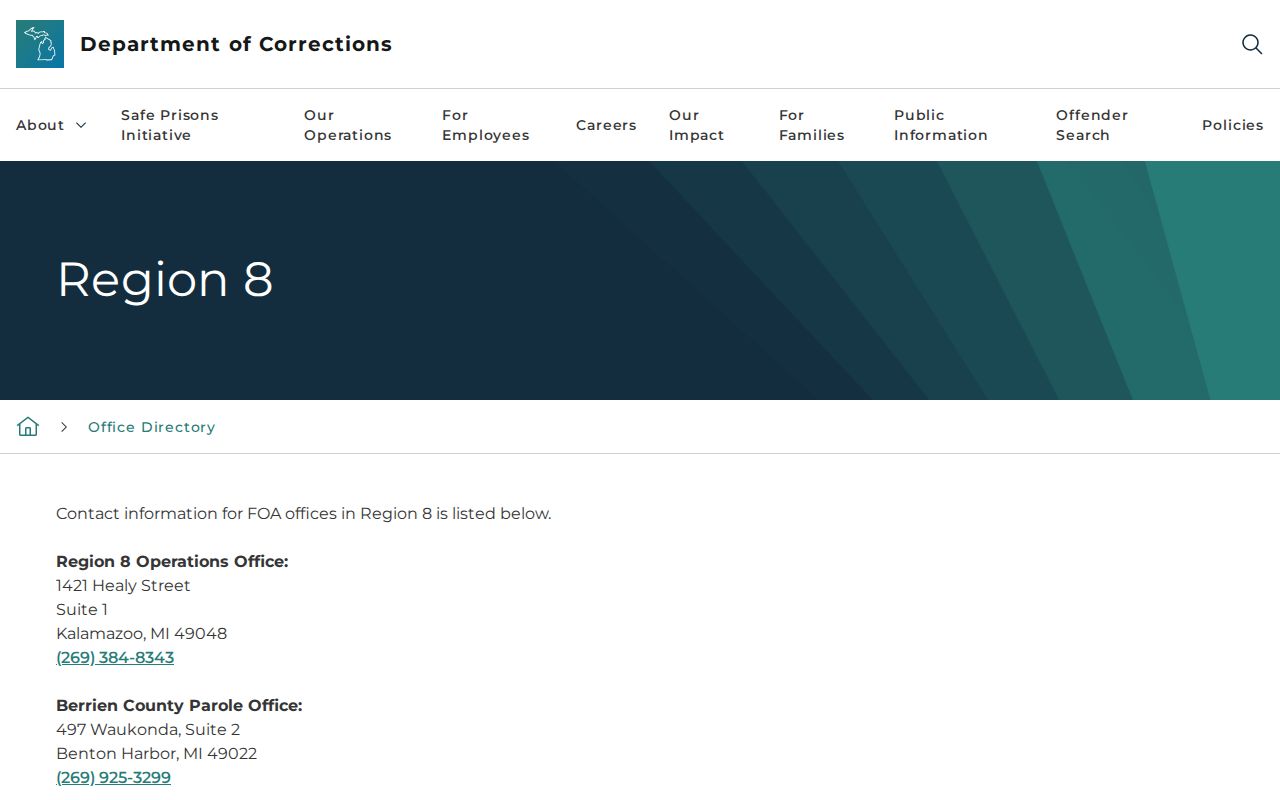
Its separate Calhoun entries reinforce why OTIS Assigned Location must be checked before contacting a supervision office.
Calhoun County Absconder and Warrant Status
OTIS includes Parole Absconders and Probation Absconders among its status filters. “Absconder” means MDOC alleges that the person failed to remain in required contact or at a required location. The Assigned Location can be the last supervising office. It is not a verified current address. Calhoun County does not publish a separate public absconder or warrant list through the Sheriff’s site.
Supervision terms can include reporting, travel limits, treatment, testing, and other case-specific rules. A violation allegation may lead to investigation, a warrant, custody, or a hearing. It does not by itself prove a final violation finding. Parole revocation concerns a person already released on parole, while a new parole decision concerns whether a prisoner may leave confinement. MDOC’s absconder tip line is 517-755-0855. Do not approach a person based on a public label; use law enforcement for an immediate concern.
The Michigan Public Sex Offender Registry is a different statutory system. It includes only people legally required to register, not all released people or all probationers. Its “Active,” “Incarcerated,” and “Absconder” labels concern registry status and do not certify a Calhoun County jail release time. The official registry view shown below can help distinguish that narrow registry from OTIS supervision records.
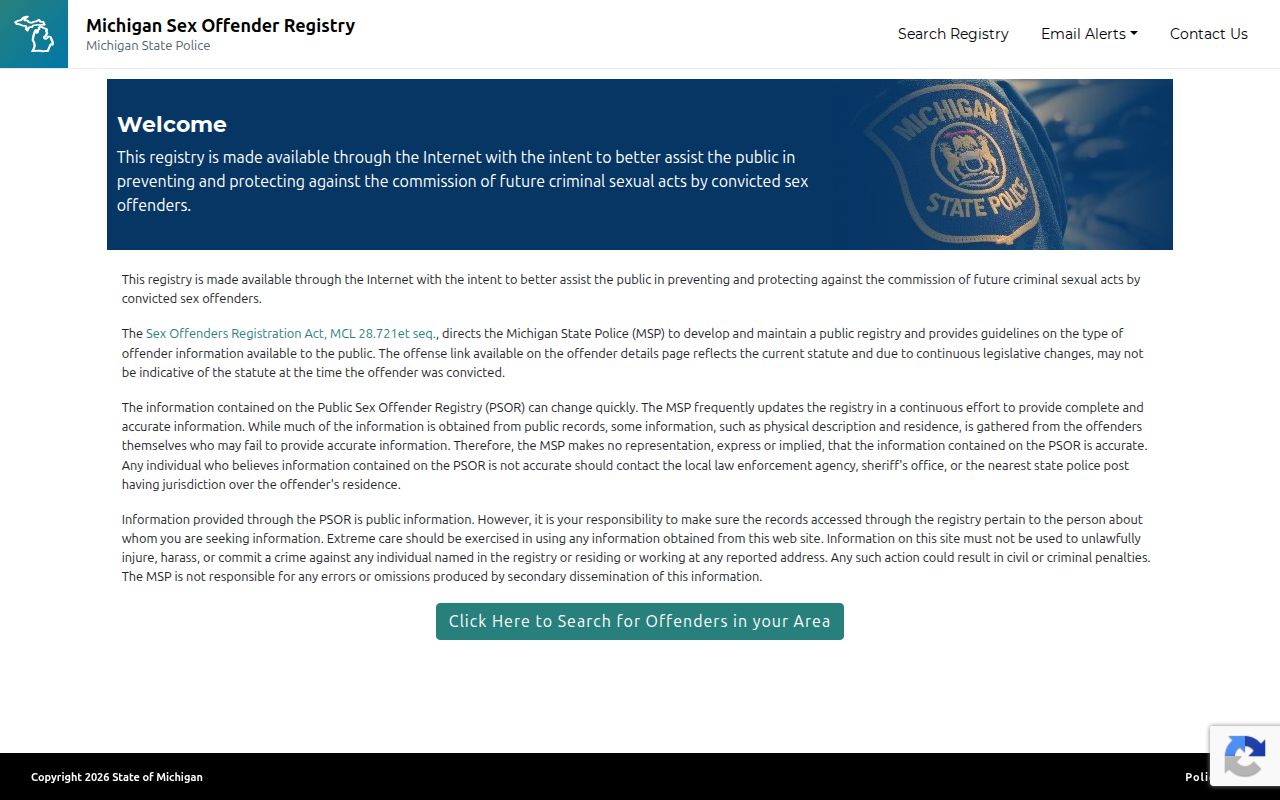
A registry match must still be checked against the actual supervising agency and custodian.
Note: An old parole date proves a past prison exit, not a current absence of warrants, holds, or renewed custody.
Calhoun County Supervision Discharge Records
Supervision ends through a discharge recorded by the responsible authority. For an MDOC case, OTIS may show Current Status “Discharged” and a Discharge Date. That differs from Date Paroled, which marks the start of parole status after prison. Michigan law keeps qualifying public OTIS records online for three years after supervision discharge, unless a set-aside, expungement, or another legal rule requires removal. Older past-prisoner records may require an MDOC records request.
When the dispute comes from a court judgment, MDOC directs the person to the sentencing court. If the issue is a supervision field, the assigned agent or office is the right starting point. A valid set-aside order must reach MDOC Records Administration before the public state record can be corrected or removed. Keep the filed order, discharge paper, and any agency reply together because each document addresses a different part of the record.
Public parole-hearing notices should not be used as discharge records. Michigan posts event-based notices for covered lifer and clemency matters, but it does not publish every routine interview as a universal calendar. A grant can precede physical release and may be suspended. A denial concerns that review, while revocation concerns alleged conduct after parole began. The current OTIS status and historical date fields remain the better public checks for a named person.
Calhoun County Release Reentry Programs
The county’s Office of Community Corrections is at 161 E. Michigan Avenue, room J212, in Battle Creek. Published hours are weekdays from 7:30 a.m. to 4 p.m. Its listed programs include Community Re-entry, pretrial services, community supervision, and START. These county services are distinct from an MDOC parole assignment, even though both may concern a person living in the community.
A recently released person with an active felony case has a specific Calhoun instruction: report to PTS–Community Corrections within 24 hours, use the first office to the left after Justice Complex security, and bring bond paperwork. That direction applies to the stated pretrial group. It should not be broadened to every released person, probationer, or parolee. The bond order and case status determine whether this local duty exists.
Correct Calhoun County Supervision Records
Bring or preserve the document tied to the problem. Bond paperwork supports the local PTS reporting route. A sentencing judgment supports a court-derived correction. An MDOC discharge record supports the end of state supervision. If OTIS shows the wrong court fact, first obtain the filed order from the sentencing court. If the error concerns Assigned Location or an absconder label, contact the assigned MDOC office or agent.
Michigan FOIA can provide existing agency records, but it does not replace a court’s authority to change its own judgment. A narrow request should identify the person, MDOC number, the field in dispute, and the source document. That makes the question easier to route and reduces the chance that parole, probation, pretrial supervision, and discharge will be treated as interchangeable.
When a profile has aged out of the public OTIS window, MDOC routes some past-prisoner records through its records contacts. Records more than three years after supervision discharge may no longer appear online even though an agency or archive still holds material. Absence must therefore be stated as “not found in the current public search,” not as proof that no supervision record exists.