
Calhoun County Projected Versus Actual Release
Michigan OTIS does not use one generic projected-release label. A state prisoner profile can show Earliest Release Date and Maximum Discharge Date. The earliest date is generally the first point at which the Michigan Parole Board has jurisdiction to consider release under the governing sentence calculation. It is not an appointment and does not guarantee a favorable parole decision. Maximum Discharge Date is the current outside endpoint of the controlling prison sentence if parole does not occur first, subject to lawful changes.
Actual release is an event, not a forecast. Date Paroled can mark the historical move from prison to parole supervision. Discharge Date marks the end of MDOC jurisdiction when paired with discharged status. For a county jail case, the final custody transaction records when Calhoun custody ended and whether the person entered the community or transferred.
Scheduled versus actual: An OTIS Earliest Release Date is eligibility for parole review. Confirm departure through current status, the custodian’s final record, and transfer or detainer information.
A pretrial detainee has no sentence-completion date. Bond, dismissal, a court release order, or resolution of a hold can change custody. A disposed case does not prove the hour someone left the Calhoun County Correctional Facility.
Find Calhoun County Projected Release Dates
Begin with the sentence and custodian. OTIS is correct for a person committed to MDOC, even when the person lived in Calhoun County or first passed through the county jail. It is not correct for a jail-only sentence. Calhoun’s Police-to-Citizen page is current-inmate information, not a sentence calculator or historical release archive.
- Check the court case in MiCOURT and use the Calhoun courts directory when the correct court is unclear. Identify whether the matter is pretrial, a county jail sentence, or an MDOC prison sentence.
- For state prison, open MDOC OTIS, search by MDOC number or name, and confirm the correct person.
- Read Current Status, Earliest Release Date, Maximum Discharge Date, and each active sentence together. Do not mix an inactive sentence with the controlling case.
- For a Calhoun jail term, call the Corrections Center at 269-969-6303 or request the existing computation and final movement from Sheriff Records.
- Check for another agency’s detainer, a consecutive sentence, or a transfer. Leaving one custodian may not mean entering the community.
For county proof, ask for the booking identifier, sentence or jail credit information held by the agency, release date and time, disposition, and destination. The Calhoun County release record path explains how the jail record and court order work together. Michigan FOIA provides existing public records, but it does not require a new sentence analysis.
Michigan Truth-in-Sentencing Release Dates
Michigan’s modern rule is not a broad percentage formula. For covered truth-in-sentencing offenses, the prisoner serves the entire judicial minimum in a secure facility before parole consideration. The phase-in applies to specified assaultive crimes committed on or after December 15, 1998 and other crimes committed on or after December 15, 2000. Those prisoners cannot use good time or disciplinary credits to cut the minimum. Disciplinary history may still affect the Board’s decision.
The MDOC truth-in-sentencing explanation shown below is the official source for that distinction.
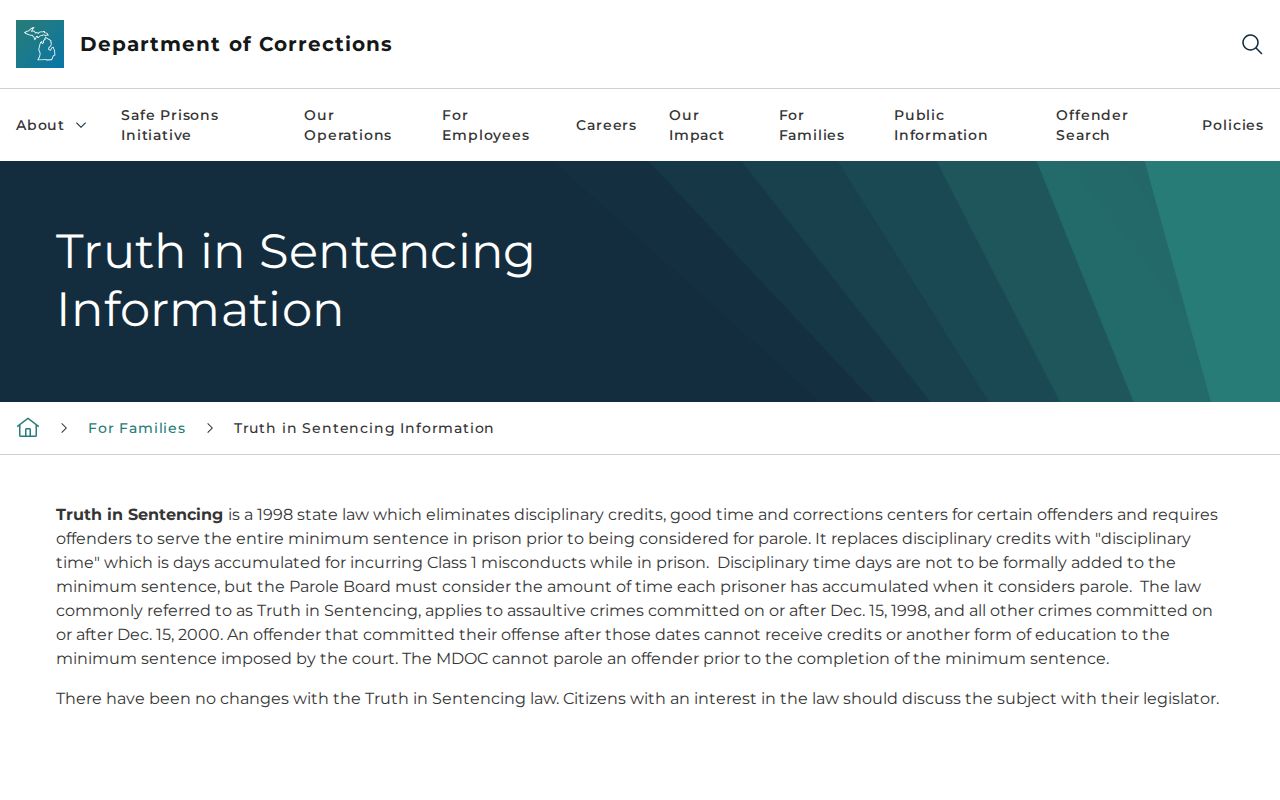
The source supports reading the full minimum term as the eligibility threshold, rather than substituting a generic percentage.
Older and offense-specific credit systems are complex. MCL 800.33 and MDOC policy distinguish good time, regular disciplinary credit, special disciplinary credit, offense-date limits, exclusions, forfeiture, and restoration. For an eligible disciplinary-credit prisoner, policy describes five regular days per month unless disqualified by Class I misconduct and up to two special days that may be granted. That narrow framework cannot be applied to modern truth-in-sentencing cases or county jail terms.
Note: No official Calhoun online county good-time formula was found, so request the actual jail computation rather than borrowing MDOC rules.
Why Calhoun County Release Dates Change
A public date reflects the record available when it was calculated. MDOC’s Time Computation Unit certifies the calculation after positive parole action, and facility records staff conduct another pre-release check. New facts can change the result. OTIS also warns that projected dates may be incomplete or out of date, so a screenshot is a dated view rather than a promise.
| Factor | Possible effect | Where to verify |
|---|---|---|
| Corrected jail credit | Changes time credited toward the sentence | Sentencing court and MDOC computation |
| Consecutive or concurrent terms | Changes how multiple sentences run | Judgment and OTIS sentence rows |
| Credit loss or restoration | Affects an eligible older calculation | MDOC records and policy |
| New sentence or court order | Can recalculate or replace a prior date | MiCOURT and filed order |
| Misconduct or adverse information | May suspend positive parole action | MDOC or Parole Board record |
| Detainer or pending charge | Can turn release into a transfer | Facility and receiving agency |
MCL 791.233 generally bars parole before the minimum less lawful allowances and sets the Board’s prerequisite. MCL 791.234 contains detailed jurisdiction rules. Life sentences require case-specific reading; some are nonparolable, while other dates depend on offense and sentence law.
Confirm Calhoun County Release Date Events
For a pending state release, check OTIS near the date and read the current status. Positive parole action can be suspended before departure. A public hearing notice proves only that a covered event is scheduled, not that parole has been granted. Routine reviews also do not all appear on the public hearing page.
Michigan VINE can provide event notifications from participating agencies. The VINELink Inmate Search explains registration for a release or transfer alert. Delivery can lag or fail, and a transfer notice is not a community release notice. Preserve the event wording, agency, identifier, and date, then confirm with MDOC or Calhoun County Correctional Facility.
For a county case, call the 24-hour Corrections Center with the full name and date of birth or booking number. Ask whether the person remains in Calhoun custody and whether departure was community release or agency transfer. Staff may limit details, so the final movement entry is the better archival record.
Read Calhoun County OTIS Date Labels
Michigan labels answer different questions. Minimum sentence is the judicial minimum. Earliest Release Date signals the first possible Board-jurisdiction point. Date Paroled records when parole began. Supervision Discharge Date concerns the supervision period. Maximum Discharge Date is the current outside end of the controlling prison sentence. A Discharge Date paired with discharged status marks the end of MDOC jurisdiction.
The official Michigan parole prerequisite page below provides the legal frame for eligibility.
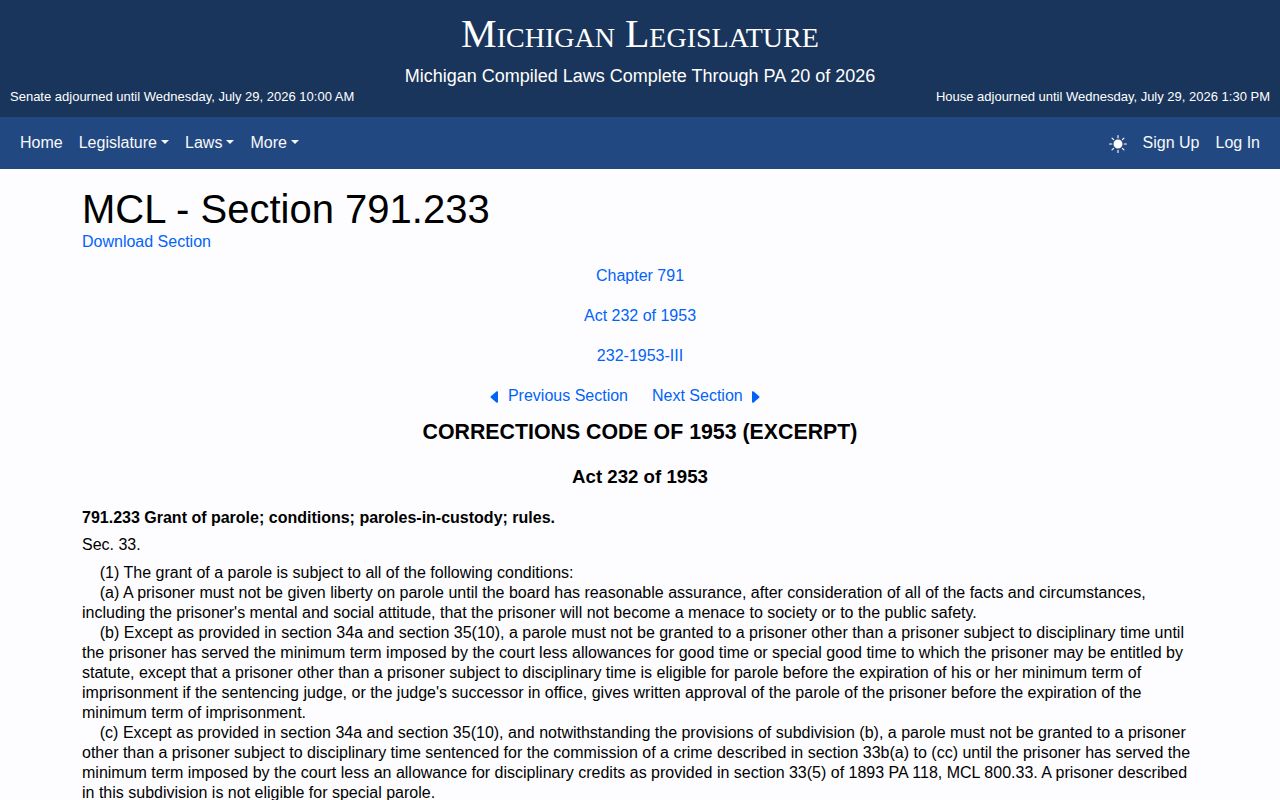
The statute helps explain why eligibility and release are separate events controlled by more than one date field.
For a released profile, Date Paroled or Discharge Date is more useful than a former projection. For a current prisoner, status and all active sentence rows keep an old date from being mistaken for the controlling term. If the court record is wrong, seek correction from the sentencing court.
Calhoun County Jail Sentence Date Lookup
Calhoun County jail computations do not appear in OTIS. A pretrial path depends on bond, court orders, and holds. For a sentenced jail term, the Sheriff and court apply the judgment and any lawful credit. Search Calhoun District or Circuit Court, then ask the jail or use the Sheriff Records Division for the existing calculation and final custody movement.
No official Calhoun weekend-release policy or online good-time method was located. That researched absence prevents a fixed estimate based on weekends, holidays, or a borrowed state-prison formula. Ask whether a current computation exists and whether any detainer or destination will take effect when county custody ends.
The court order and jail record have different roles. A judgment shows the sentence, credit ordered by the judge, and legal authority. The jail’s custody movement shows when Calhoun physically ended its custody and identifies a recorded destination when one exists. A bond order may authorize release, but staff still must process the order and check other holds. Comparing both sources avoids turning a legal authorization into an unsupported exit time.
Calhoun County Release Date Evidence
A strong answer records the source, status, date label, and time checked. For an MDOC prisoner, save the MDOC number and identify whether the profile said Prisoner, Parolee, or Discharged. Then record the exact label, such as Earliest Release Date or Maximum Discharge Date. For a county detainee, preserve the booking number and the final custody entry. This prevents the same date from being repeated later without its limiting context.
| Custody path | Date evidence | What it does not prove |
|---|---|---|
| Calhoun pretrial | Bond or release order plus final jail movement | No future fixed date before the court acts |
| Calhoun jail sentence | Judgment, lawful credit, and jail computation | OTIS absence says nothing about the term |
| MDOC prisoner | OTIS active sentence dates and current status | Earliest Release Date is not a grant |
| MDOC parolee | Date Paroled and parolee status | Parole is not final discharge |
| Agency transfer | Calhoun destination and receiving-agency record | Leaving the jail is not community release |
A missing public result is inconclusive. OTIS excludes jail-only cases and generally removes records more than three years after supervision discharge. P2C is current-custody oriented. MiCOURT can omit confidential matters and can apply display limits. When the expected record is absent, verify spelling and identifiers, check the correct system, and request the existing record from the office that created it.
A namesake match is equally risky. Compare date of birth, MDOC number, court case number, and booking identifier where available. Sentence dates can be attached to multiple active and inactive rows. The controlling term must be identified before any maximum or earliest date is repeated as the answer.
Calhoun County Parole Action and Release
The Michigan Parole Board is the paroling authority for felony offenders committed to MDOC. Board jurisdiction at the minimum date permits consideration; it does not compel release. A public hearing notice only shows that a covered proceeding is set. Routine case reviews may not appear in the notices, and the public notice list can also include pardon or commutation matters that are not ordinary parole.
A favorable action can still precede a records review, time computation certification, and facility check. A new detainer, charge, protective order, misconduct report, or other adverse information may suspend or alter the action. If the final plan is parole to a detainer, physical departure from an MDOC prison transfers the person to another agency. It is not a return to the Calhoun community.